Political and social transformations
By the end of the 15th century, Toledo occupied a prominent position within the Crown of Castile. Building on a long history spanning Visigothic, Islamic and Christian eras, the city was one of the kingdom’s principal political, religious and economic centres.
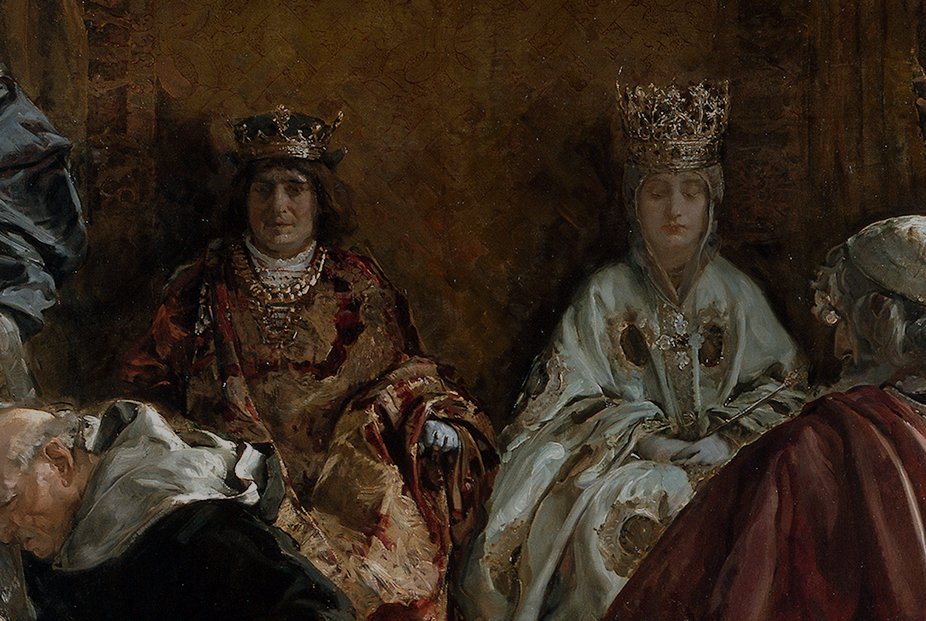
When Isabella I of Castile and Ferdinand II of Aragon consolidated their power towards the end of the 15th century, Toledo took on particular significance as the setting for political and administrative decisions. Although the Crowns of Castile and Aragon retained their own laws and institutions, the Catholic Monarchs introduced reforms aimed at strengthening the authority of the monarchy and improving the administration of their territories.

Toledo under Al-Andalus: art and culture
Discover Islamic art in Toledo during the Al-Andalus period, its origins, main characteristics and the cultural legacy that the city still preserves today.
Political reforms: Toledo as a centre of power
One of the most significant moments took place at the Cortes of Toledo in 1480. These sessions addressed numerous issues relating to justice, government and the organisation of the monarchy. Among other measures, the Royal Council, one of the principal governing institutions of the Crown of Castile, was reorganised, and the role of jurists and lawyers within the administration was strengthened.
The convening of these Cortes demonstrates Toledo’s political importance during the reign of the Catholic Monarchs. The city hosted representatives from various towns and cities across Castile, as well as nobles and members of the clergy, temporarily becoming a key centre for the Crown’s political activity.
The monarchy also gradually strengthened its presence in the towns through institutions such as the corregidores, representatives of the Crown responsible for intervening in the government and administration of municipal justice. These measures formed part of a broader process of strengthening royal authority in Castile.
Urban transformations and the architecture of power
The reign of the Catholic Monarchs also left a significant mark on Toledo’s urban landscape. One of the most notable examples is the monastery of San Juan de los Reyes, commissioned by the monarchs from 1477 onwards to commemorate their victory at the Battle of Toro in 1476. The work was commissioned from the architect Juan Guas and became one of the finest examples of Hispano-Flemish Gothic architecture.
The construction of San Juan de los Reyes was not solely for religious purposes: the building also served to express the monarchs’ power and political image. Its coats of arms, inscriptions and decoration directly linked the urban space with the monarchy’s new image.

Blog link: The Origin of the Yoke and the Arrows
Discover the origins of the Yoke and the Arrows: the emblems of the Catholic Monarchs, Isabella of Castile and Ferdinand of Aragon
These transformations took place within a city that remained complex and densely built-up, with neighbourhoods and spaces associated with different communities and activities. Rather than a complete reconstruction of Toledo, the period of the Catholic Monarchs was characterised by specific interventions and by a growing institutional and symbolic presence of the monarchy.
Thus, the reign of the Catholic Monarchs marked a period of strengthening of monarchical authority and of significant political, religious and urban changes. Toledo continued to be one of the great centres of power of the Crown of Castile, although it was not yet a permanent capital: the court of the Catholic Monarchs moved between different cities.
Toledo’s political and symbolic importance was to continue into the 16th century, when the city assumed an even more prominent role under Charles I, prior to the court’s relocation to Madrid in 1561.
How important was Toledo during the reign of the Catholic Monarchs?
Toledo was one of the most important cities in the Crown of Castile due to its historical, political, economic and religious significance. Although it was not a permanent capital, it played a prominent role in the consolidation of the power of Isabella I of Castile and Ferdinand II of Aragon.
What were the Cortes of Toledo of 1480?
These were a series of meetings of representatives of the kingdom convened by the Catholic Monarchs, at which significant political and administrative reforms were introduced. Among other measures, government institutions were strengthened and progress was made in reorganising the administration of the Crown of Castile.
What urban developments took place in Toledo during this period?
During the reign of the Catholic Monarchs, architectural projects were undertaken that reflected the power of the monarchy. One of the most notable examples was the monastery of San Juan de los Reyes, the construction of which began in 1477 on the monarchs’ initiative.
How significant was the monastery of San Juan de los Reyes?
The monastery of San Juan de los Reyes was a religious and political project promoted by Isabella I and Ferdinand II. Its Gothic architecture and symbolism helped to symbolise the authority of the monarchy and left a lasting mark on Toledo’s historical heritage.
Why did Toledo cease to be such an important political centre?
Toledo was not a permanent capital, as the monarchs’ court moved between different cities. Although it retained its importance during the reign of Charles I, in 1561 Philip II established the court in Madrid, which went on to become the monarchy’s main political centre.