A suit of armour that conceals far more than meets the eye
At first glance, The Burial of the Count of Orgaz, one of El Greco’s greatest works, stands out for its monumental composition and the depiction of a miracle. However, when we look more closely at the painting, we discover small details that reveal the painter’s extraordinary skill.
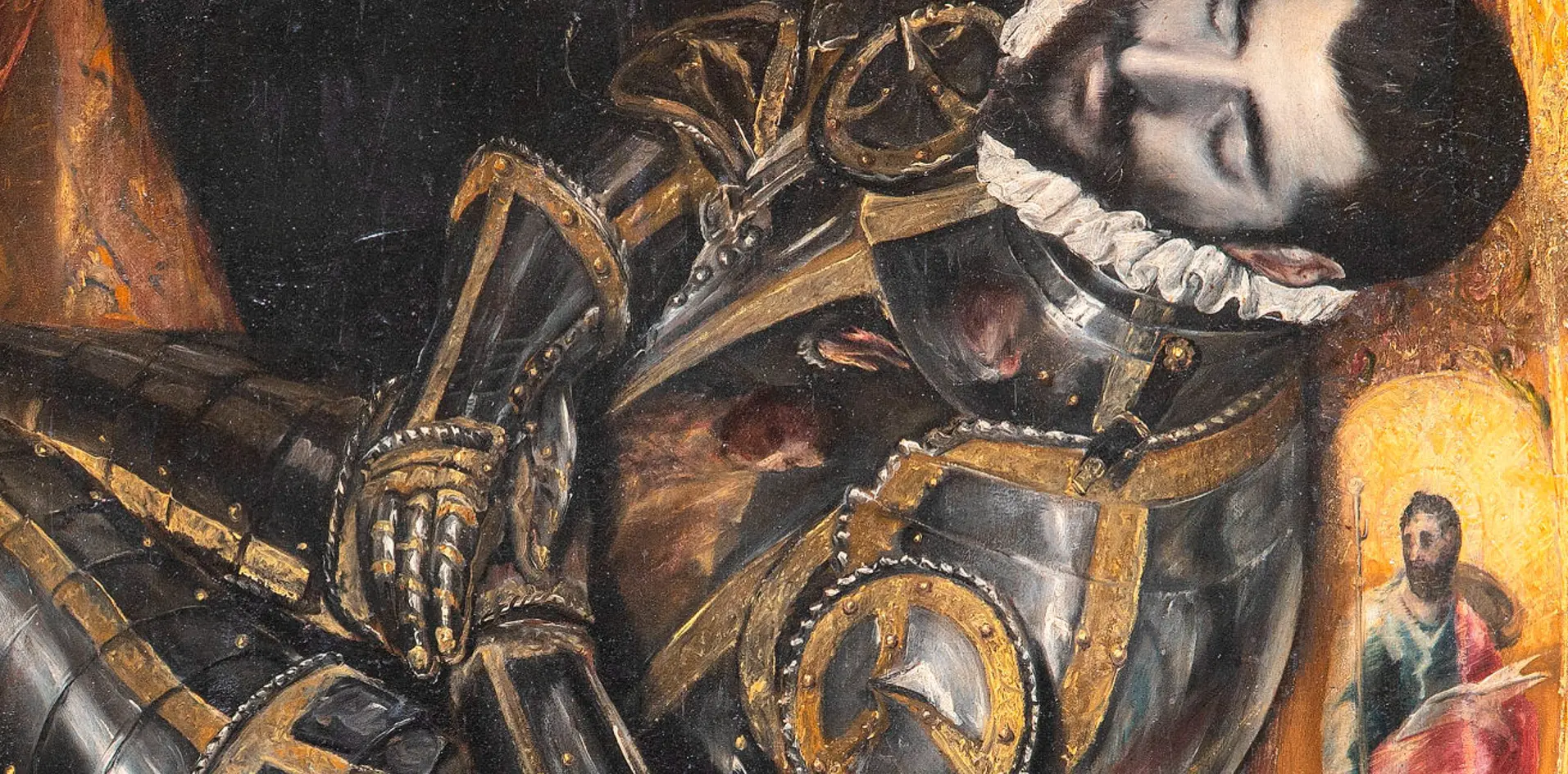
One of the most intriguing details can be found in the deceased’s gleaming suit of armour: a metallic surface in which some of the figures in the scene appear to be reflected.
A masterpiece rich in detail
El Greco painted The Burial of the Lord of Orgaz between 1586 and 1588 for the Church of Santo Tomé in Toledo. The work depicts the miraculous burial of Gonzalo Ruiz de Toledo, Lord of Orgaz, during which, according to tradition, Saint Augustine and Saint Stephen descended from heaven to lay his body in the tomb.
The composition is divided into two realms: the earthly realm, where the burial takes place, and the heavenly realm, presided over by Christ and accompanied by the Virgin Mary, St John the Baptist and other sacred figures.
At the centre of the lower scene we find the deceased, clad in armour whose gleam contrasts with the dark robes of those in attendance and the rich vestments of the saints.
The mystery of the reflections on the armour
The armour is not merely an example of El Greco’s technical mastery. Its polished surface features details that appear to reflect images of the figures surrounding the deceased.
One of these has been identified as the reflection of Saint Stephen, the young saint who, alongside Saint Augustine, is holding the body of the Lord of Orgaz. The possible appearance of his figure on the metal creates a visual link between the saint and the nobleman, reinforcing the connection between the two within the miraculous scene.
But there is another, even more intriguing detail: a shape that has been interpreted as the reflection of a hand. According to a hypothesis put forward in the video, it could belong to a civil authority, possibly a mayor of Toledo.
This identification should not be regarded as confirmed. Nevertheless, it raises an interesting possibility: that El Greco made use of the reflections on the armour to visually incorporate the figures attending the funeral.
If that interpretation were correct, the detail might suggest a link between the civil and religious authorities present at the event. It is, however, a possible interpretation, not a proven meaning.
The mastery of light and materials
These details demonstrate El Greco’s ability to depict different surfaces through the contrast between light and shadow. The glints and tonal variations make the armour appear to be a real metallic object, capable of reflecting everything happening around it.
Its central position also helps to direct the viewer’s gaze towards the body of the deceased and the two saints supporting him. Thus, an element of the costume becomes a key part of the composition.
El Greco, who had worked in Italy before settling in Toledo, developed a personal style characterised by his elongated figures, his colour contrasts and his distinctive conception of space.
The reflections on the armour are an example of how a small detail can open up new ways of contemplating a great work of art. For, beyond its religious significance, The Burial of the Count of Orgaz continues to invite us to observe closely every figure, every gesture and every glint of light, to discover all that the painting conceals.


